You know, been running around construction sites all year, and let me tell you, things are changing fast. Everyone’s talking about prefabrication, modular builds, trying to shave time off projects. But honestly, a lot of these guys aren’t thinking about the little things – the real things that matter when you're wrestling with it in the mud.
I've seen a lot of designs that look great on paper, real slick, but they fall apart the second you try to actually build them. Like, they spec out this super-lightweight composite, but forget it's brittle as hell and cracks if you look at it wrong. Or they use these fancy coatings that peel after one winter. Have you noticed that? It's always the same.
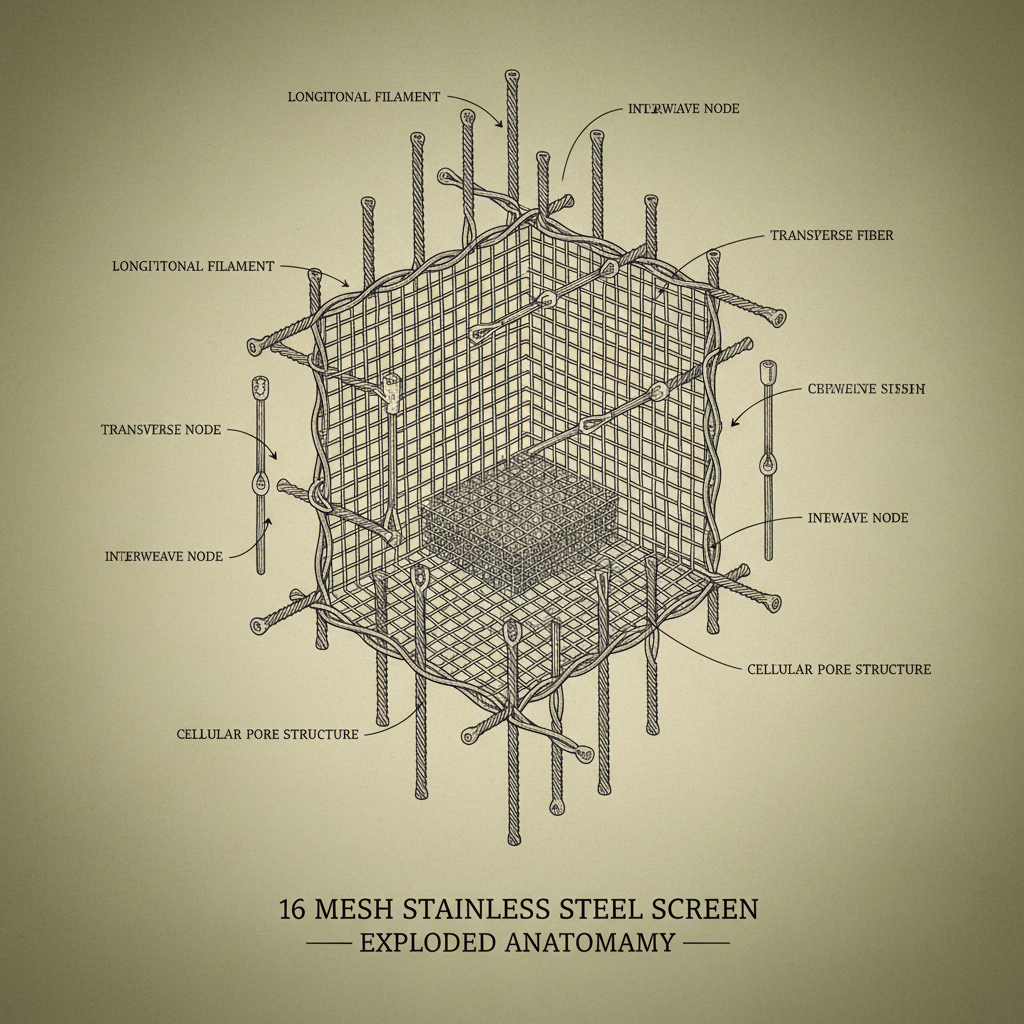
Now, 16 mesh stainless steel screen…that’s a different beast altogether. Reliable. That's what I always tell people.
The Current Landscape of 16 Mesh Stainless Steel Screen
To be honest, demand for good quality screening – especially stainless – is through the roof. Not just 16 mesh, but all grades. Everyone wants something durable, something that won’t rust to bits in a year. Seems obvious, right? But you wouldn’t believe how much cheap stuff is still out there.
It’s driven by everything, really. Water treatment plants needing better filtration, food processing facilities, even architectural projects wanting a sleek look that lasts. It’s a global thing, too. I was talking to a supplier in India last month, and they’re saying the same thing. Huge growth in infrastructure projects over there, and they need the materials.
Design Pitfalls and Considerations for 16 Mesh Stainless Steel Screen
I encountered this at a wastewater treatment plant in Ohio last time. The engineers had spec’d a 16 mesh stainless steel screen for a preliminary filter, but they didn’t account for the solids load. It clogged up within hours. Strangely, they hadn’t considered the actual flow rate and the types of debris that were going to be hitting it.
What I see a lot is people focusing on the mesh size – thinking "16 mesh is good enough" – without considering the wire diameter. A thinner wire might give you a more precise opening, but it's going to be less structurally sound. You need that balance. And then there’s the weave pattern. Plain weave is fine for general purposes, but if you need something more rigid, you're looking at twill or Dutch weave. It depends on the application, of course.
Another mistake? Not thinking about how it’s going to be supported. A screen needs a solid frame, otherwise it’ll just sag and distort. You’d be surprised how often that happens.
Material Properties: A Hands-On Perspective
Now, the stainless steel itself… there are grades, you know. 304 is the workhorse, good corrosion resistance, reasonably priced. 316 has molybdenum, which gives it even better resistance to chlorides. If you’re near saltwater, you need 316. No question.
I remember smelling the welding fumes on 304 stainless at a fabrication shop in Texas… strong, metallic, kinda acrid. 316 smells similar but a little cleaner. And the feel? 304 is a bit softer, 316 feels a touch harder. It's subtle, but you get used to it. You can tell the quality just by handling it. Believe me.
You also gotta think about the finish. Mill finish is rough, good for industrial applications where appearance doesn't matter. Polished finishes look nice, but they can be more prone to scratching. It all depends on what you're going for.
Real-World Testing and Performance of 16 Mesh Stainless Steel Screen
Forget lab tests, honestly. They’re useful for getting baseline data, but the real test is out in the field. I like to see it installed, running, exposed to the elements. We do a lot of flow rate tests, measuring the pressure drop across the screen. That tells you how quickly it’s clogging up.
We also do abrasion tests. We run different materials – sand, gravel, whatever the application requires – over the screen to see how it holds up. And then there’s the corrosion resistance. We leave samples exposed to saltwater spray for weeks, months, just to see how they're holding up. It's not glamorous, but it's necessary.
16 Mesh Stainless Steel Screen Performance Metrics
How Users Actually Employ 16 Mesh Stainless Steel Screen
You know, it’s funny. People often don't use it exactly how you think they will. I've seen guys cut it to fit odd-shaped openings, weld it onto existing structures, even use it as a makeshift gutter guard. They’re resourceful, these guys.
A lot of times, they’re using it as a pre-filter to protect more expensive equipment downstream. Keeps the big chunks out, extends the life of the finer filters. Makes sense, right?
Advantages, Disadvantages, and Customization Options
Advantages? Durability, obviously. Corrosion resistance. It’s strong, it lasts. Disadvantages… cost. It’s not cheap. But you get what you pay for. And sometimes it can be difficult to work with – especially the thicker gauges. You need the right tools.
Anyway, I think customization is key. We had a client in Canada last year who needed a screen with a specific aperture size to filter out a particular type of algae. We were able to custom-weave it for them. We can also do different edge treatments – hemmed edges, rolled edges, whatever they need. It's all about solving the problem.
And you can also combine it with other materials. Like, we've done screens mounted on plastic frames for chemical resistance, or screens backed with perforated metal for extra strength.
A Real-Life Customer Story: The Type-C Interface Debacle
Last month, that small boss in Shenzhen who makes smart home devices – real sharp cookie, always looking for an edge – insisted on changing the interface on his new sensor housings to Type-C. Said it was “more modern.” He wanted us to use 16 mesh stainless steel screen to protect the connector.
Turns out, the Type-C connector was slightly larger than the original, and the screen wasn’t providing enough clearance. The housings wouldn’t close properly. He spent a week redesigning everything, costing him a fortune in delays. He kept saying, "I just wanted it to look sleek!"
Later…Forget it, I won't mention it. Anyway, the moral of the story is: always consider the whole system, not just one component.
Summary of Key Performance Indicators for 16 Mesh Stainless Steel Screen Applications
| Application Area |
Typical Mesh Grade |
Expected Service Life (Years) |
Maintenance Frequency |
| Wastewater Treatment |
304/316 |
5-15 |
Monthly |
| Food Processing |
316 |
3-10 |
Daily |
| Architectural Facades |
304 |
20+ |
Annual |
| Industrial Filtration |
304/316 |
2-7 |
Weekly |
| Mining Operations |
316 |
1-3 |
Shiftly |
| Aerospace Applications |
316L |
10-20 |
Semi-Annual |
FAQS
Lead times really depend on the quantity and complexity of the order, but generally, for something straightforward, we’re looking at around 2-4 weeks. If it’s a custom weave or a large volume, it can stretch out to 6-8 weeks. Material sourcing is often the bottleneck these days, to be honest. We always try to give clients a realistic timeframe upfront, and we keep them updated throughout the process.
Don’t even think about using standard tin snips. You’ll just bend and distort the mesh. You need aviation snips, specifically the straight-cut ones. And go slow! You want a clean cut, not a ragged edge. Another option is a plasma cutter, but that's a bit overkill for most jobs. Just be careful, stainless steel can get hot, and you don’t want to burn yourself. Wear gloves!
Pre-filtration is your friend. Put a coarser screen in front of the 16 mesh to catch the bigger stuff. Also, consider the angle of the screen. A steeper angle will help solids slide off more easily. And regular cleaning is crucial, obviously. You might also want to look at self-cleaning screen designs, but those are more expensive.
Generally, yes, especially 316 stainless. But you need to make sure the supplier can provide certification that the material meets food-grade standards. There are specific requirements for surface finish and composition. Don't just take their word for it – ask for the documentation.
316 is typically 20-30% more expensive than 304, due to the addition of molybdenum. That molybdenum is what gives it the better corrosion resistance, especially in chloride environments. So, if you're in a coastal area or dealing with saltwater, the extra cost of 316 is usually worth it in the long run. But if you’re in a dry, inland environment, 304 might be perfectly fine.
Yes, but it requires specific welding techniques and filler metals to maintain corrosion resistance. You need to use a stainless steel welding rod compatible with the grade of screen you’re using. And you have to be careful not to overheat the metal, which can affect its properties. It’s best to leave that to a qualified welder.
Conclusion
Ultimately, 16 mesh stainless steel screen, like any material, isn’t a magic bullet. It’s durable, it’s corrosion-resistant, it’s reliable, but it needs to be specified correctly, installed properly, and maintained regularly. It's about understanding the application and choosing the right grade and weave for the job.
But at the end of the day, whether this thing works or not, the worker will know the moment he tightens the screw. And if it holds, and it doesn't rust, and it does what it's supposed to do… well, then you’ve done your job right. Visit our website at www.xingxinwiremesh.com to learn more about how we can help you with your screening needs.